
Rules and rate checked as of 14 November 2026
If you have a daughter under 10 years old, you have probably heard that the Sukanya Samriddhi Yojana (SSY) is one of the best ways to save for her education and marriage. It pays a high, government-backed interest rate, and the interest and maturity amount are tax-free.
But SSY is also one of the most misunderstood schemes. Many websites and even some bank pages still quote rules from before 2019: a ₹1,000 minimum deposit, the girl operating the account from age 10, “withdrawal for marriage”, and compulsory closure if the family moves abroad. None of these is correct today.
This guide sets out the rules that apply right now, in plain language, including withdrawals, what happens if the girl or the parent dies, and the latest changes. It ends with a parent’s checklist and 12 frequently asked questions.
1. What is the Sukanya Samriddhi Yojana?
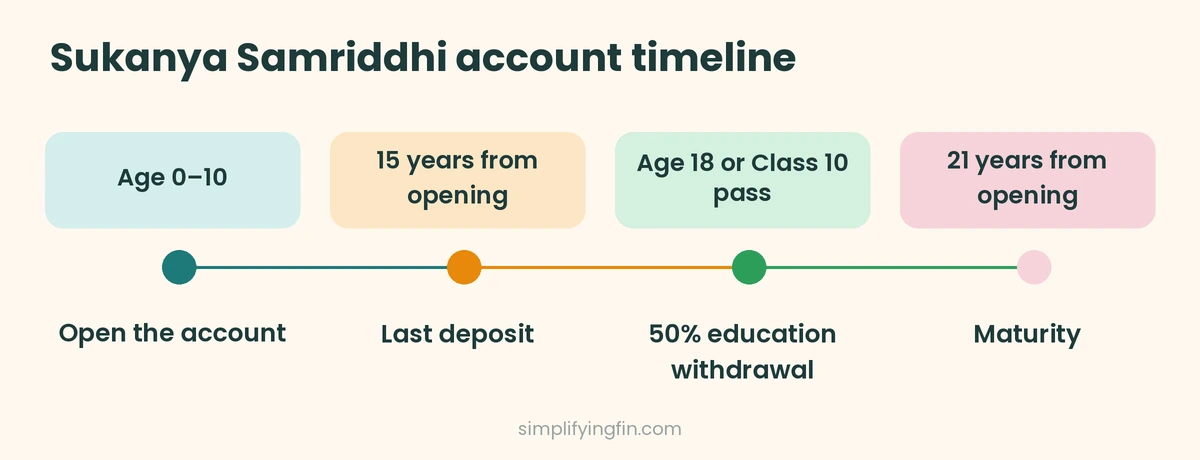
SSY is a small savings scheme of the Government of India, launched in 2015 for the benefit of the girl child. A parent or legal guardian opens the account in the girl’s name, deposits money for 15 years, and the account matures after 21 years.
The scheme is governed by the Sukanya Samriddhi Account Scheme, 2019 (notified on 12 December 2019 as G.S.R. 914(E)), as amended. For matters the Scheme does not cover, such as nomination, claims and transfers, the Government Savings Promotion General Rules, 2018 apply.
Where can you open it? At any post office, or at a branch of an authorised bank: all public sector banks, plus ICICI Bank, Axis Bank and HDFC Bank.
What about the RBI? The RBI does not fix SSY’s rules or interest rate. Those come from the Ministry of Finance (Department of Economic Affairs). The RBI’s role is to oversee the banks that act as the government’s agents. Its latest instrument is the Conduct of Government Business by Agency Banks Directions, 2026, dated 30 April 2026, and the transactions are settled through the RBI’s Central Accounts Section in Nagpur. So the binding sources for SSY are the 2019 Scheme, the Finance Ministry’s notifications and your bank’s or post office’s own circulars.
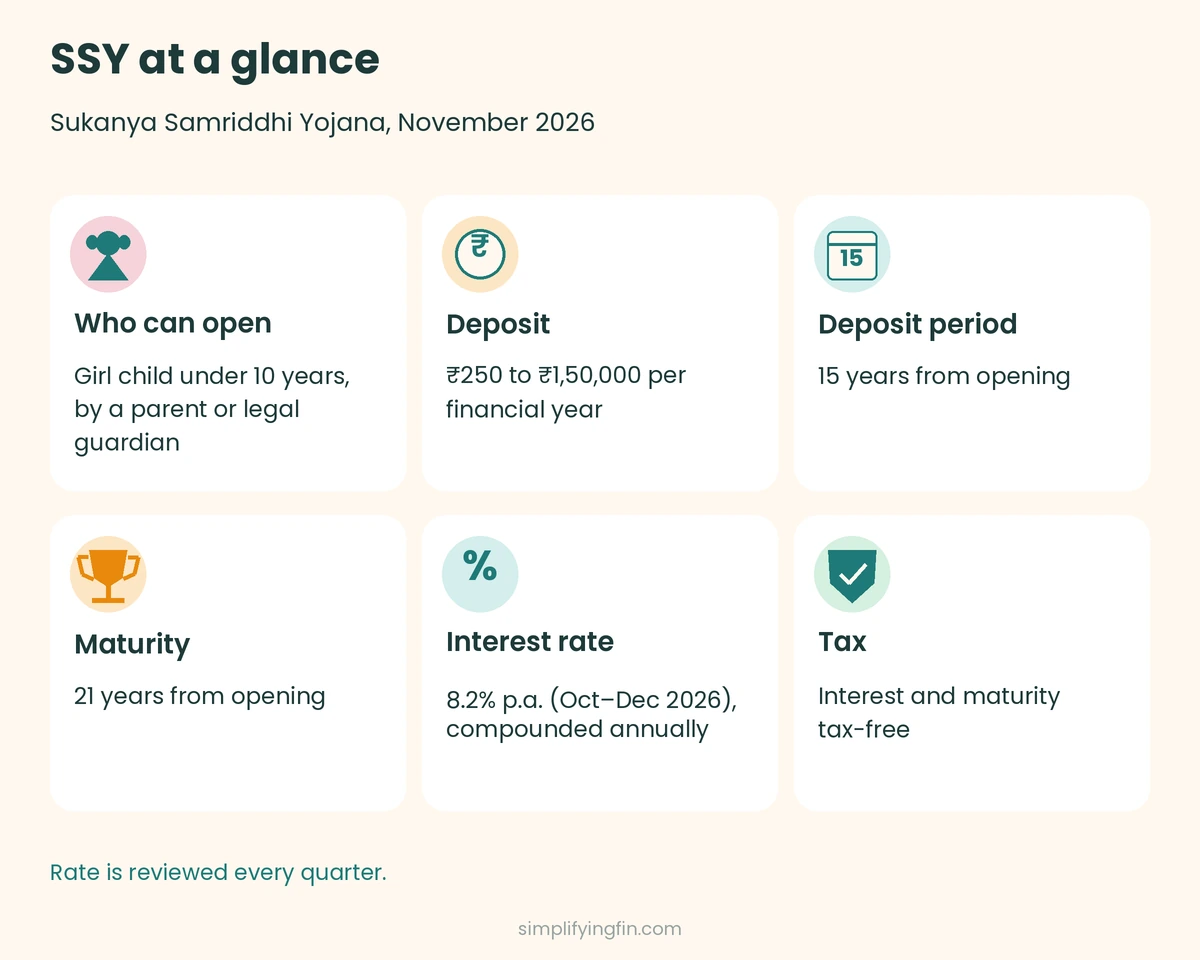
2. SSY at a glance (November 2026)
| Feature | Current rule |
|---|---|
| Interest rate | 8.2% per annum (Oct–Dec 2026), compounded annually |
| Who can open | Girl child under 10 years on the date of opening |
| Who opens it | Parent or legal guardian |
| Accounts allowed | 1 per girl; 2 girls per family (twins/triplets exception) |
| Minimum deposit | ₹250 per financial year |
| Maximum deposit | ₹1,50,000 per financial year |
| Deposit period | 15 years from opening |
| Maturity | 21 years from opening |
| Operated by | Guardian until the girl turns 18; then the girl |
| Tax | Interest and maturity tax-free; deposit deduction under the old tax regime only |
| Loan facility | Not available |
3. Current interest rate: 8.2% for October–December 2026
The Finance Ministry’s office memorandum of 30 September 2026 kept the SSY rate at 8.2% for the third quarter of FY 2026-27 (1 October to 31 December 2026). The rate was last raised on 1 January 2024, when it went from 8.0% to 8.2%, and it has stayed there since. The next review is due around the end of December 2026 for January–March 2027.
Two important points:
- The rate is floating, not fixed. Your entire balance earns whatever rate is notified for each quarter. It is not locked at the rate on the day you open the account.
- The government can change it every quarter, so any long-term projection is only an estimate.
How interest is calculated
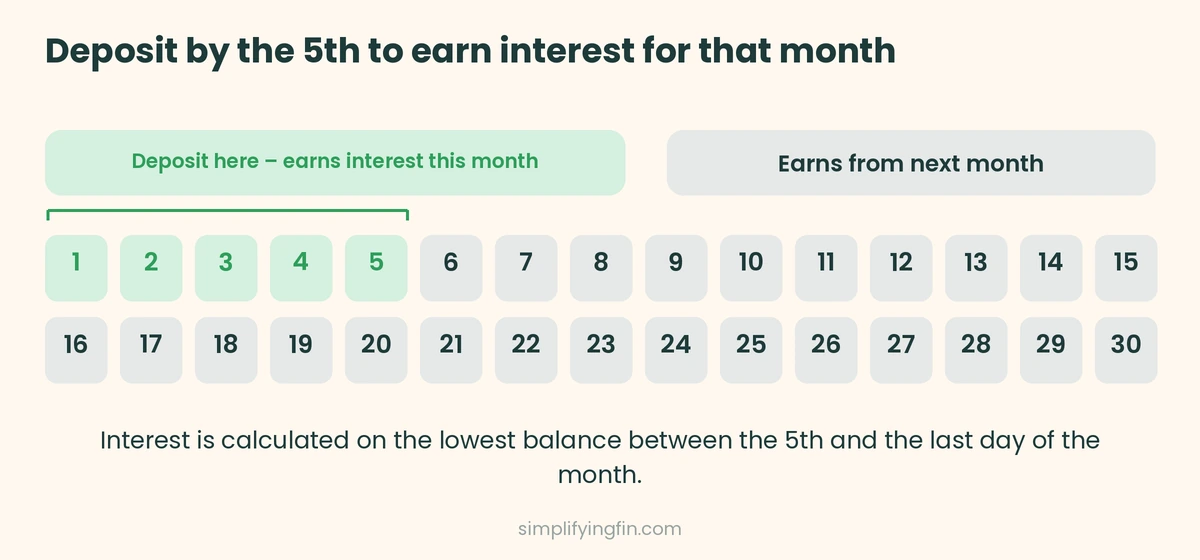
Interest is calculated every month on the lowest balance between the 5th day and the last day of the month. It is credited once a year, on 31 March, and added to your balance, so it compounds annually.
What this means for you: deposit on or before the 5th of the month. A deposit made on the 6th earns nothing for that month. To earn a full year’s interest on your annual deposit, put it in by 5 April.
What could you build?
The table below assumes one deposit every April for 15 years and 8.2% throughout. It is an illustration, not a promise.
| Yearly deposit | Total deposited (15 yrs) | Approx. value after 15 years | Approx. maturity value (year 21) |
|---|---|---|---|
| ₹50,000 | ₹7.5 lakh | ₹14.9 lakh | ₹23.9 lakh |
| ₹1,50,000 | ₹22.5 lakh | ₹44.8 lakh | ₹71.8 lakh |
Related calculators: Sukanya Samriddhi Calculator | PPF Calculator | RD Calculator | Bank FD Calculator
4. Eligibility and how to open an account
Age: The girl must be under 10 years on the date of opening.
Who can open it: Either parent, or a legal or court-appointed guardian. Grandparents are not guardians while a parent is alive (more on this in section 11).
Number of accounts:
- Only one account per girl, anywhere in India.
- Maximum two girls per family.
- If the second birth is twins or triplets (or the first birth gives twins and the second gives another girl), a third account may be allowed on an affidavit with birth certificates.
- Joint accounts are not permitted.
Residency: The girl must be a resident Indian citizen at the time of opening. NRIs cannot open a new account.
Documents:
- Account opening form (Form-1)
- The girl’s birth certificate
- The guardian’s Aadhaar and PAN (or Form 60) and photographs
- Nomination details (SBI’s FAQ treats nomination as mandatory at opening)
5. Deposit rules
- Opening deposit: at least ₹250. The old ₹1,000 minimum no longer applies.
- Amounts: in multiples of ₹50, between ₹250 and ₹1,50,000 per financial year. You may deposit as often as you like within that limit.
- Duration: deposits are accepted for 15 years from opening.
- Modes: cash, cheque, demand draft, bank transfer, net or mobile banking, or standing instruction. At post offices you can also use India Post e-banking or the IPPB app.
- Excess deposits: anything above ₹1.5 lakh in a year earns no interest and has to be refunded.
What if you miss a year?
If you do not deposit at least ₹250 in a financial year, the account is “in default”. You can revive it at any time within the 15-year deposit period by paying ₹250 plus a ₹50 penalty for each missed year, so ₹300 per year.
Here is a point many people get wrong: since the 2019 rules, even an account that is never revived continues to earn the full scheme rate. Older articles that say a defaulted account earns only savings rate are out of date. Still, regularise it. Missing deposits means missing the whole point of the scheme.
6. Tax benefits (EEE status)
SSY is an “Exempt-Exempt-Exempt” product:
- Deposit: deductible up to ₹1.5 lakh a year, shared with PPF, ELSS, life insurance premium and other eligible items. Until FY 2025-26 this was Section 80C. From 1 April 2026, under the Income-tax Act, 2025, it is Section 123 (read with Schedule XV). The deduction is available only if you choose the old tax regime.
- Interest: tax-free every year.
- Maturity amount: tax-free.
If you file under the new tax regime, you lose only the deduction on deposits. The interest and maturity proceeds stay tax-free in both regimes. The deduction is claimed by the parent or guardian who makes the deposit.
7. Who operates the account, and transfers
Guardian until 18. Under the 2019 Scheme the guardian operates the account until the girl turns 18, not 10 as older rules said. After 18, the girl operates it herself after submitting her own KYC.
Change of guardian. If the guardian dies or a court orders a change, the succeeding guardian operates the account.
Transfers. If you move cities, don’t open a new account. You may transfer the account between branches, from bank to bank, from bank to post office and vice versa, anywhere in India. The girl can only ever have one account. Post offices charge ₹100 for a transfer; banks have their own charges, and many don’t charge for scheme transactions. Interest is still credited on 31 March even if the account moved during the year.
8. Withdrawal rules
This is where most confusion arises. Money is meant to stay in the account for the long term, and the rules allow only specific exits.
Partial withdrawal: for education only
- When: once the girl turns 18, or has passed Class 10, whichever is earlier.
- How much: up to 50% of the balance at the end of the preceding financial year.
- How: as a lump sum, or in instalments up to once a year for a maximum of five years, limited to the actual fees and charges.
- Proof: Form-3 plus the institution’s admission letter or fee slip.
- The remaining balance continues to earn the scheme rate.
Marriage is not a ground for partial withdrawal. Many websites say “withdrawal for education or marriage”. Under the 2019 Scheme, partial withdrawal is for education. Marriage is dealt with through premature closure, as below.
Premature closure
| Situation | Conditions | Interest |
|---|---|---|
| Marriage | Girl must be at least 18 on the date of marriage. Apply between 1 month before and 3 months after the wedding. Needs a notarised declaration on stamp paper and age proof | Scheme rate up to closure |
| Death of the girl | Account closed immediately; no five-year wait | Scheme rate up to date of death, savings rate (4%) after that |
| Life-threatening illness of the girl, or death of the guardian | Only after 5 years from opening, and the account office must approve in writing | Full scheme rate up to closure |
A change of residence is no longer a ground for closure. An account that is not wanted can otherwise only be closed on these grounds or at maturity.
9. Maturity: closing at 21 years
The account matures 21 years from the date of opening, which is not the same as the girl turning 21. If she opened at age 2, it matures when she is 23.
To claim, the girl submits Form-4 with her KYC. Please don’t leave the money sitting after maturity: a matured but unclosed account earns only the post office savings rate of 4% and not the 8.2%. Close it promptly.
10. What happens in case of death?
This section is the one parents worry about the most, and the Scheme has clear provisions.
If the girl (account holder) dies
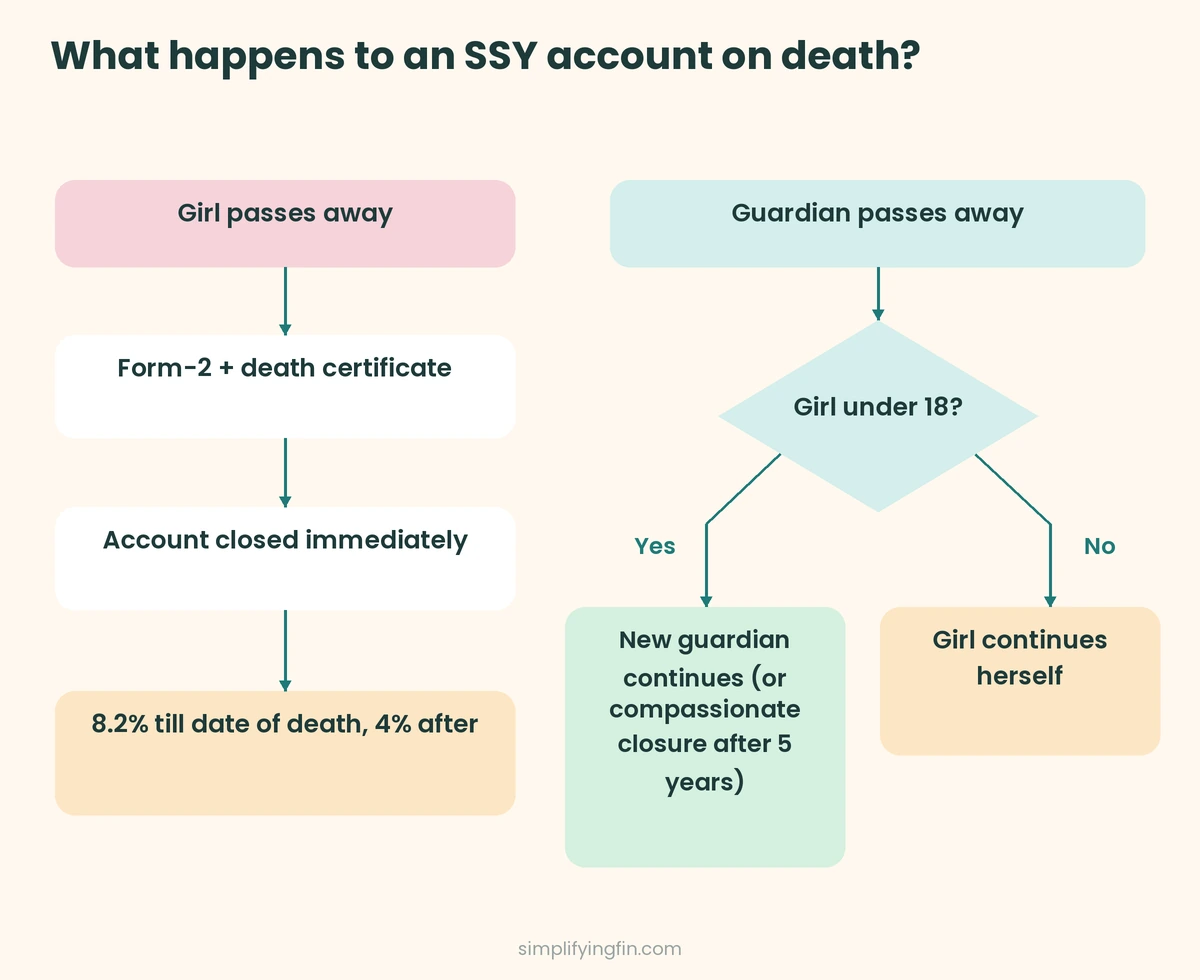
- The guardian applies on Form-2 with the death certificate and the passbook.
- The account is closed immediately; there is no five-year lock-in for this case.
- Interest is paid at the scheme rate (8.2%) up to the date of death, and at the post office savings rate (4%) from the date of death until the account is closed.
- The payment goes to the guardian under the Scheme text (SBI’s FAQ mentions the nominee; in practice the guardian is usually also the nominee).
Practical tip: claim quickly. Every month of delay earns 4% instead of 8.2%.
If the parent or guardian dies while the girl is under 18
- By default, the account continues. The surviving parent, or the person who is legally entitled or court-appointed as guardian, takes over. They need to submit the death certificate of the earlier guardian, their own KYC and proof of guardianship. Deposits can carry on.
- If continuing is a hardship, the account can be closed on compassionate grounds, but only after 5 years from opening and with approval. Full scheme interest is paid.
- After the girl turns 18, she operates the account herself, so the guardian’s death makes no difference to operation.
11. Special cases and recent changes
Accounts opened by grandparents
A Finance Ministry office memorandum of 12 July 2024, circulated by India Post on 21 August 2024 and reported as effective from 1 October 2024, deals with accounts opened by someone who is not the natural or legal guardian, typically grandparents. Guardianship of such accounts has to be moved to the girl’s parents or legal guardian. The parent applies at the branch with the girl’s birth certificate, proof of relationship and KYC. If you opened an account for your granddaughter, ask the parents to complete this process.
More than the allowed number of accounts
Accounts beyond the family limit (outside the twins/triplets exception) are treated as opened in contravention of the scheme and are to be closed. The memorandum does not say what interest such accounts will get, and regularisation power rests with the Ministry of Finance, so these cases are referred upward rather than decided at the branch.
If the girl or guardian becomes an NRI
Under the older rules the account had to be closed. Under the 2019 Scheme, read with the General Rules, the account can continue until maturity on a non-repatriation basis, with no interest beyond maturity. Please report the change of residency to your branch.
No amendment to the SSY Scheme itself was found for 2025 or 2026. Be careful with social media claims about “new SSY rules” and check the Gazette, National Savings Institute or India Post circulars.
12. Parent’s checklist
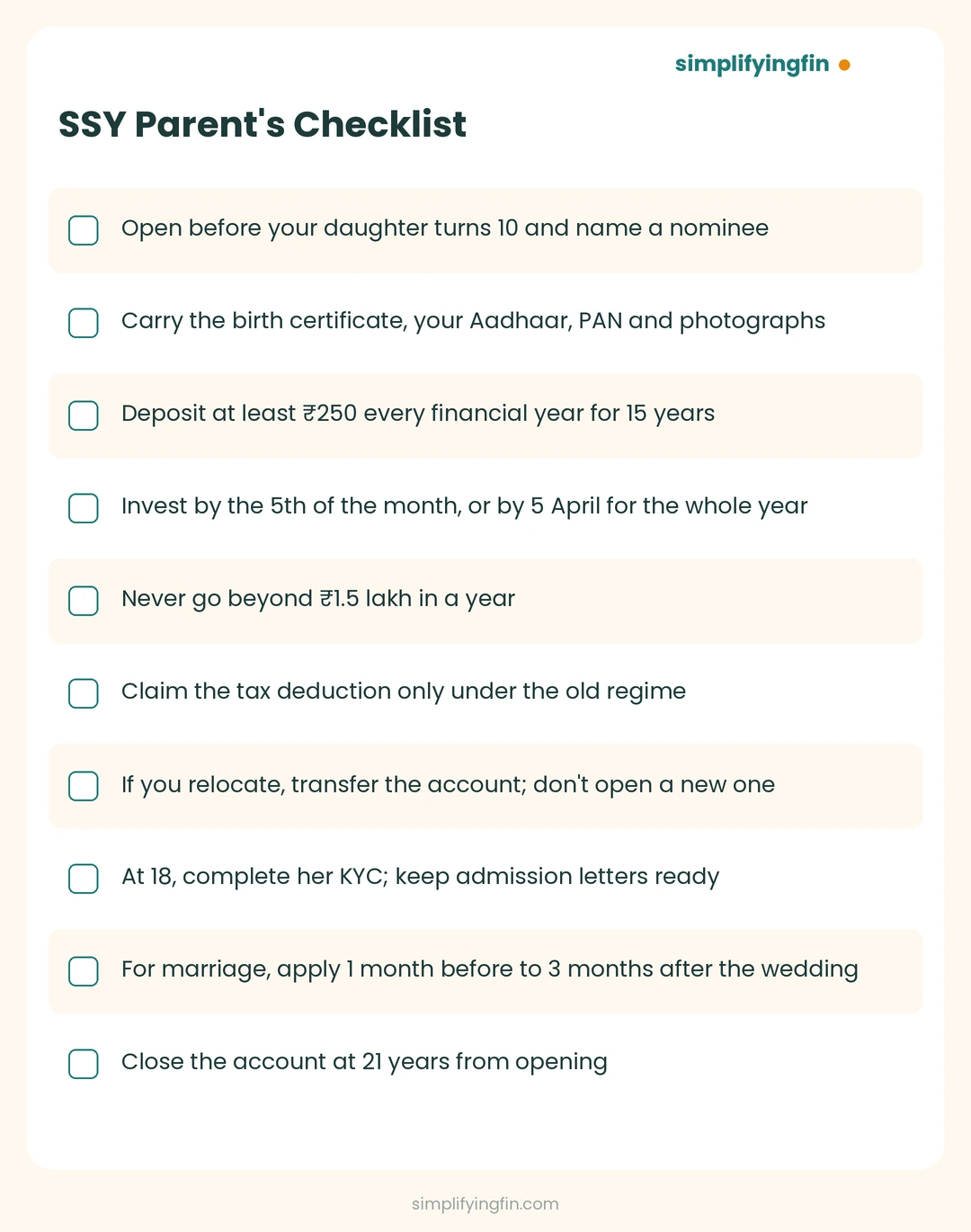
- ☐ Open the account before your daughter turns 10, as the parent or legal guardian, and name a nominee.
- ☐ Carry the birth certificate, your Aadhaar, PAN and photographs.
- ☐ Deposit at least ₹250 every financial year for 15 years. Ideally invest by the 5th of the month, or by 5 April for the whole year.
- ☐ Never go beyond ₹1.5 lakh in a year; the excess earns nothing.
- ☐ Claim the tax deduction only if you file under the old regime.
- ☐ If you relocate, transfer the account; don’t open a new one.
- ☐ At 18, complete her KYC so she can operate it. Keep admission letters ready for education withdrawals.
- ☐ Apply for closure for marriage between 1 month before and 3 months after the wedding.
- ☐ Close the account at 21 years from opening to avoid the 4% rate.
- ☐ Keep the passbook, death-claim documents and nominee details where the family can find them.
13. Frequently asked questions (FAQs)
What is the current Sukanya Samriddhi interest rate?
For October–December 2026 it is 8.2% per annum, compounded annually, unchanged since 1 January 2024. It is reviewed every quarter.
Can I open an SSY account for a girl who is above 10 years old?
No. The girl must be under 10 years on the date of opening.
How many accounts can I open?
One per girl and two girls per family. A third account is possible only for twins or triplets born in the first or second birth, with an affidavit and birth certificates.
What is the minimum and maximum yearly deposit?
The minimum is ₹250 and the maximum is ₹1,50,000 per financial year, in multiples of ₹50.
What happens if I miss a yearly deposit?
The account goes into default. You can revive it within the 15-year deposit period by paying ₹250 plus ₹50 penalty for each missed year. Even if you never do, the balance continues to earn the scheme rate, but regularising is the better course.
Can I withdraw money for my daughter’s marriage?
Not as a partial withdrawal. You can close the account prematurely for marriage if the girl is at least 18, applying from one month before to three months after the wedding.
How much can be withdrawn for education?
Up to 50% of the balance at the end of the previous financial year, once the girl is 18 or has passed Class 10, whichever is earlier. It can be taken as a lump sum or as yearly instalments for up to five years, with proof of fees.
Is SSY interest taxable? Does the new tax regime allow a deduction?
Interest and maturity proceeds are tax-free under both regimes. The deduction on deposits (now Section 123 of the Income-tax Act, 2025) is available only under the old regime.
Can I transfer my account to another city or bank?
Yes, anywhere in India: between branches, banks and post offices. The post office fee is ₹100, and banks may have their own charges.
What happens to the account if my daughter passes away?
The account is closed immediately. You get scheme-rate interest up to the date of death and 4% from then until closure, paid to the guardian. File Form-2 with the death certificate quickly.
What happens if I, the parent, die?
The account continues under the surviving parent or the new legal guardian. If it becomes a hardship, it can be closed with full interest, but only after the account is five years old.
What happens after 21 years, and can I take a loan against SSY?
The account matures 21 years after opening. If you don’t close it, it earns only 4%. No loan is available against SSY.
Final thoughts
SSY remains one of the safest ways to build a large, tax-efficient corpus for a daughter: a government-backed 8.2%, a long compounding runway, and tax-free proceeds. The rules that trip parents up are the small ones: deposit before the 5th, keep depositing for 15 years, don’t let grandparents open accounts, and close the account promptly at maturity.
Before acting on any specific case, such as a death claim or a corrective transfer, confirm the procedure with your bank or post office, since their internal formats and forms can differ.
Disclaimer: This article is for general information and is not financial, tax or legal advice. Rates change every quarter and rules can be amended; please verify on the official National Savings Institute, India Post or your bank’s website before you decide.
Sources and further reading
- National Savings Institute: https://www.nsiindia.gov.in
- SBI Sukanya Samriddhi FAQs: https://sbi.bank.in/web/faq-s/faq-sukanya-samriddhi-account
- RBI Directions on agency banks (30 April 2026): https://www.rbi.org.in
- India Post savings schemes: https://www.indiapost.gov.in