
A simple guide for beginners and Indian stock market investors
If you have ever read a stock analysis, you have probably seen ROE vs ROCE come up again and again. Both tell you how good a company is at turning money into profit. But they are not the same thing, and using the wrong one can give you a misleading picture of a business.
In this guide, we explain both ratios in plain language, with easy examples from the Indian context. By the end, you will know exactly what ROE and ROCE mean, how to calculate them, and when to use which one.
The short answer
- ROE (Return on Equity) tells you how much profit the company earns on the money that belongs to its shareholders.
- ROCE (Return on Capital Employed) tells you how much profit the company earns on all the money used in the business, both shareholders’ money and borrowed money.
- If the company has significant debt, look at ROCE. If the company has no debt, ROE works well.
First, a simple way to think about it
Imagine you start a small business, say a flour mill in Gujarat. You put in ₹10 lakh of your own savings and borrow another ₹10 lakh from a bank. At the end of the year, the mill earns a profit.
- If you ask, “How much did I earn on my own ₹10 lakh?”, you are thinking about ROE.
- If you ask, “How much did the mill earn on the total ₹20 lakh invested?”, you are thinking about ROCE.
That one difference, whether borrowed money is counted or not, is the heart of this whole topic.
What is ROE (Return on Equity)?
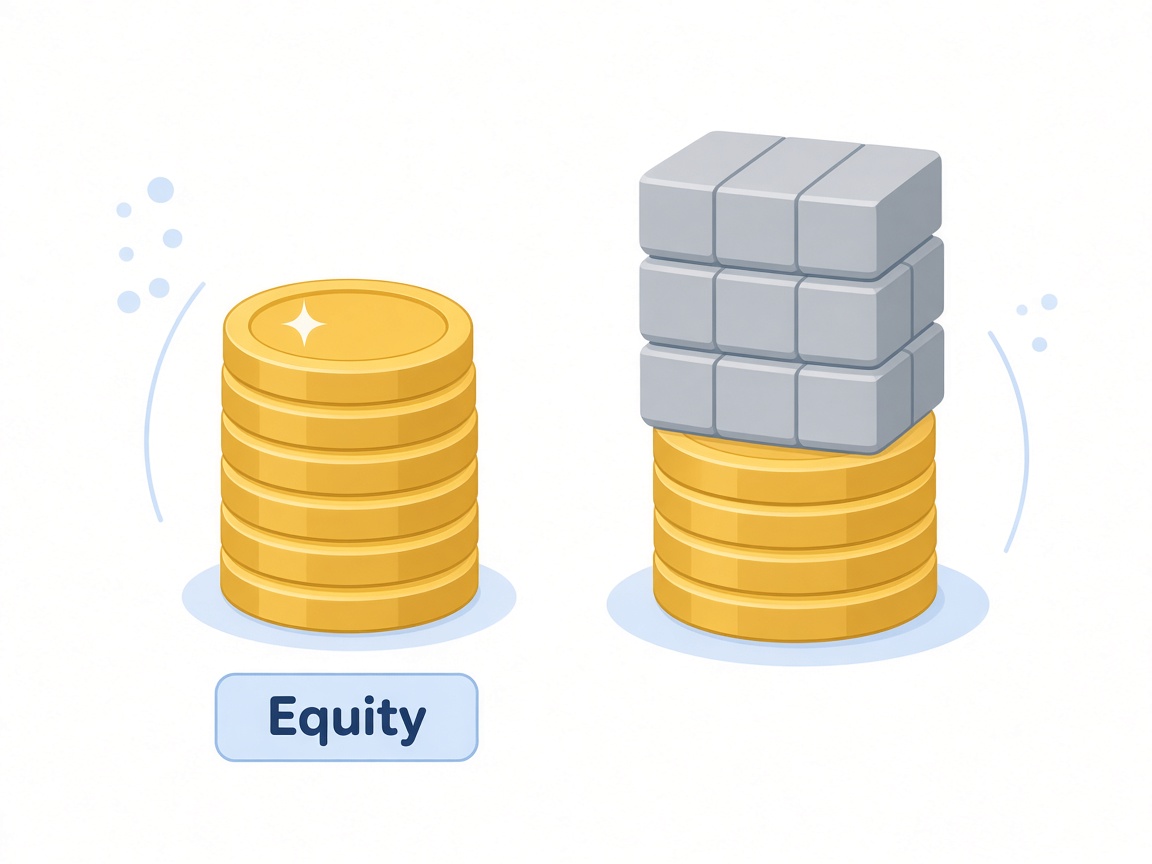
ROE shows how efficiently a company uses its shareholders’ money to make profit. The higher the ROE, the more profit the company generates for every rupee that shareholders have invested or left in the business.
ROE formula
ROE = Net Profit ÷ Shareholders’ Funds × 100
Here is what each part means:
- Net Profit is the Profit After Tax (PAT). This is what is left after paying all expenses, interest and tax.
- Shareholders’ Funds (also called Net Worth) = Equity Share Capital + Reserves and Surplus. In a balance sheet, “reserves” and “surplus” are the profits the company has earned in earlier years and kept in the business.
Tip: Many analysts use the average of the opening and closing shareholders’ funds of the year instead of only the year-end figure. This gives a fairer picture because the equity changes during the year. Whichever method you choose, use the same one for every company you compare.
Example: ROE of an imaginary company
Sharma Textiles Ltd. has the following numbers (in ₹ crore):
| Item | Amount (₹ crore) |
|---|---|
| Equity share capital | 100 |
| Reserves and surplus | 900 |
| Shareholders’ funds | 1,000 |
| Profit after tax (PAT) | 120 |
ROE = 120 ÷ 1,000 × 100 = 12%
This means that for every ₹100 of shareholders’ money, the company earned ₹12 as profit during the year.
What is ROCE (Return on Capital Employed)?
ROCE shows how well a company uses all the capital it has, whether that money came from shareholders or from lenders such as banks. It answers a simple question: “For every ₹100 invested in this business in total, how much operating profit does it earn?”
ROCE formula
ROCE = Operating Profit (EBIT) ÷ Capital Employed × 100
Where:
- Capital Employed = Equity Share Capital + Reserves and Surplus + Debt (borrowings).
- Operating Profit (EBIT) = Earnings Before Interest and Tax. It is the profit the business earns from its core operations, before paying interest to lenders and before paying tax.
Note for advanced readers: Capital employed is also commonly worked out as Total Assets minus Current Liabilities, which gives a very similar figure. For a beginner, the “equity + reserves + debt” method is easier to understand.
Why do we use EBIT and not net profit in ROCE?
This is the point where many beginners get confused, so let us make it simple.
In ROCE, we already include debt in the denominator (the bottom part of the formula). Debt is part of the capital that the company is using. If we also subtracted the interest on that debt from the profit in the numerator, we would be counting the cost of debt twice. That would make the ratio look smaller than it really is.
So we use EBIT, the profit before interest, to match the capital that includes debt.
Example: ROCE of an imaginary company
Gujarat Auto Components Ltd. has the following numbers (in ₹ crore):
| Item | Amount (₹ crore) |
|---|---|
| Shareholders’ funds (equity + reserves) | 1,000 |
| Debt (borrowings) | 500 |
| Capital employed | 1,500 |
| Operating profit (EBIT) | 270 |
| Interest paid on debt (10% of 500) | 50 |
ROCE = 270 ÷ 1,500 × 100 = 18%
Now see what happens if we make the common mistake of subtracting interest as well:
(270 − 50) ÷ 1,500 × 100 = 220 ÷ 1,500 × 100 = 14.67%
This is wrong, because interest has already been accounted for by including debt in the capital. The correct ROCE is 18%.
ROE vs ROCE: Key differences at a glance
| Point | ROE | ROCE |
|---|---|---|
| Full form | Return on Equity | Return on Capital Employed |
| Whose money is counted? | Only shareholders’ money | Shareholders’ money + borrowed money |
| Profit used | Net Profit (PAT), after interest and tax | Operating Profit (EBIT), before interest and tax |
| Capital used | Equity share capital + reserves and surplus | Equity share capital + reserves and surplus + debt |
| Best used when | Company has little or no debt | Company has significant debt |
Which ratio should you use?
If the company has external debt, use ROCE
When a company borrows money from banks or other lenders, ROE alone can be misleading. Borrowing reduces the equity needed, so a company can show a high ROE simply by taking on more loans, even if the business itself is not any better. ROCE avoids this problem because it looks at the business performance regardless of how it is funded.
Let us see this with an example. Two imaginary companies, Company A and Company B, run similar businesses. Both use a total capital of ₹1,000 crore and both earn an EBIT of ₹150 crore. The only difference is how they funded the business. Assume tax of about 25% for simplicity (figures in ₹ crore).
| Company A (no debt) | Company B (heavy debt) | |
|---|---|---|
| Shareholders’ funds | 1,000 | 400 |
| Debt | 0 | 600 |
| Capital employed | 1,000 | 1,000 |
| EBIT | 150 | 150 |
| Interest (9% on debt) | 0 | 54 |
| Profit before tax | 150 | 96 |
| Tax (25%) | 37.5 | 24 |
| Profit after tax | 112.5 | 72 |
| ROE | 11.25% | 18% |
| ROCE | 15% | 15% |
Look at the result. Company B’s ROE (18%) looks much better than Company A’s (11.25%). But the ROCE of both is exactly the same at 15%, which tells us the underlying businesses are equally good. Company B’s higher ROE came only from using borrowed money.
And that borrowing brings risk. Imagine a slow year when EBIT falls to ₹60 crore for both:
- Company A: No interest to pay. Profit before tax is ₹60 crore, profit after tax is ₹45 crore, and ROE is 4.5%.
- Company B: Interest of ₹54 crore still has to be paid. Profit before tax is only ₹6 crore, profit after tax is ₹4.5 crore, and ROE falls to about 1.1%.
This is why debt makes ROE look attractive in good times and dangerous in bad times. For companies with debt, ROCE gives a safer and more honest view.
If the company has no external debt, use ROE
When a company has no borrowings, all of its capital comes from shareholders. In that case, equity and capital employed are the same thing, so ROE is a perfectly good measure. The two ratios will be close to each other. The small difference that remains is because ROE uses profit after tax, while ROCE uses profit before tax.
Remember: ROCE is a pre-tax return and ROE is a post-tax return. So do not expect the two numbers to match exactly, even for a debt-free company.
A quick rule of thumb
- Company has meaningful loans → focus on ROCE.
- Company is debt-free or almost debt-free → ROE is enough.
- When in doubt, look at both. If ROE is much higher than ROCE, find out whether debt is the reason.
Does dividend affect ROE?
This is a very common doubt among new investors, and the answer is simple.
Dividend is not deducted from profit
ROE is calculated using the net profit (PAT) before any dividend is paid. A dividend is not an expense of the business. It is a share of the profit given to shareholders. So the net profit used in ROE is the full profit, whether the company later keeps it or distributes part of it.
When does a dividend reduce shareholders’ funds?
A dividend reduces the shareholders’ funds (specifically, the reserves) when it is formally declared, that is, when it is approved and becomes a legal obligation of the company. It does not wait for the actual bank payment.
In India, there are two common cases:
- Interim dividend: declared by the Board of Directors during the year. It reduces equity in the year it is declared.
- Final dividend: recommended by the Board after the year ends and approved by shareholders at the Annual General Meeting (AGM). Under Indian Accounting Standards (Ind AS 10), a dividend declared after the balance sheet date is not shown as a liability or deducted from equity in that balance sheet. It reduces equity in the next financial year, when it is approved.
Good to know: There is no single official formula for ROE in the accounting standards. ROE is an analyst’s ratio, so always check how a website or report has calculated it (year-end or average equity) before comparing numbers.
Example
Patel Foods Ltd. earned a profit after tax of ₹100 crore this year. Its shareholders’ funds were ₹950 crore at the start of the year and ₹1,050 crore at the end. The average is ₹1,000 crore.
ROE = 100 ÷ 1,000 × 100 = 10%
Now suppose that after the year ends, the Board recommends a final dividend of ₹20 crore. This does not change this year’s ROE. It stays at 10%. Once shareholders approve it at the AGM, the ₹20 crore will reduce the equity in the next year’s calculation.
What is a good ROE or ROCE?
There is no magic number, but here are some simple guidelines used by many investors:
- A ROE or ROCE that stays above 15% year after year is generally considered healthy for a business.
- Consistency matters more than one good year. Check the last 5 to 10 years, not just the latest one.
- Compare within the same industry. An FMCG company and a power company have very different capital needs, so comparing their ratios directly is not fair.
- The return should be higher than the interest rate the company pays on its loans. If a company borrows at 10% but earns only 8% on its capital, it is slowly destroying value.
Common mistakes to avoid
- Looking at ROE alone for a company with a lot of debt. Always check the debt level too.
- Subtracting interest in ROCE. Use EBIT, as explained above.
- Using ROCE for banks and NBFCs. For these, borrowing (such as customer deposits) is their raw material, not just a source of funds. Their capital employed is not meaningful in the usual way, so analysts mostly use ROE (and ROA) for them.
- Judging by a single year. One year can be unusually good or bad. Look at the trend.
- Comparing numbers from different sources. Websites may calculate these ratios slightly differently. Compare like with like.
Key takeaways
- ROE = Net Profit ÷ (Equity Share Capital + Reserves and Surplus). It shows the return on shareholders’ money.
- ROCE = EBIT ÷ (Equity Share Capital + Reserves and Surplus + Debt). It shows the return on all capital used in the business.
- ROCE uses EBIT because debt is already included in the capital. Interest should not be deducted again.
- Use ROCE when the company has debt and ROE when it has none.
- Dividends are not deducted from profit when calculating ROE. They reduce equity only once they are formally declared.
- Look for consistent returns over many years and compare companies within the same industry.
Frequently asked questions
1. What is the difference between ROE and ROCE?
ROE measures profit earned on shareholders’ money only. ROCE measures profit earned on all capital, including borrowed money.
2. Which is better, ROE or ROCE?
Neither is better in every case. ROCE is more reliable for companies with debt, while ROE is fine for debt-free companies. Looking at both gives the best picture.
3. Why is EBIT used in ROCE?
Because debt is already part of the capital in the formula, we use the profit before interest. Subtracting interest again would count the cost of debt twice.
4. Can ROE be high even when a company is risky?
Yes. A company can show a high ROE simply by borrowing heavily. That is why you should always check debt and ROCE alongside ROE.
5. What is a good ROCE for an Indian company?
Many investors look for a ROCE consistently above 15%, but the right level depends on the industry. Always compare a company with others in its own sector.
Disclaimer: This article is for education only and is not investment advice. The companies and figures used in the examples are imaginary. Please do your own research or consult a SEBI-registered investment adviser before making investment decisions.