
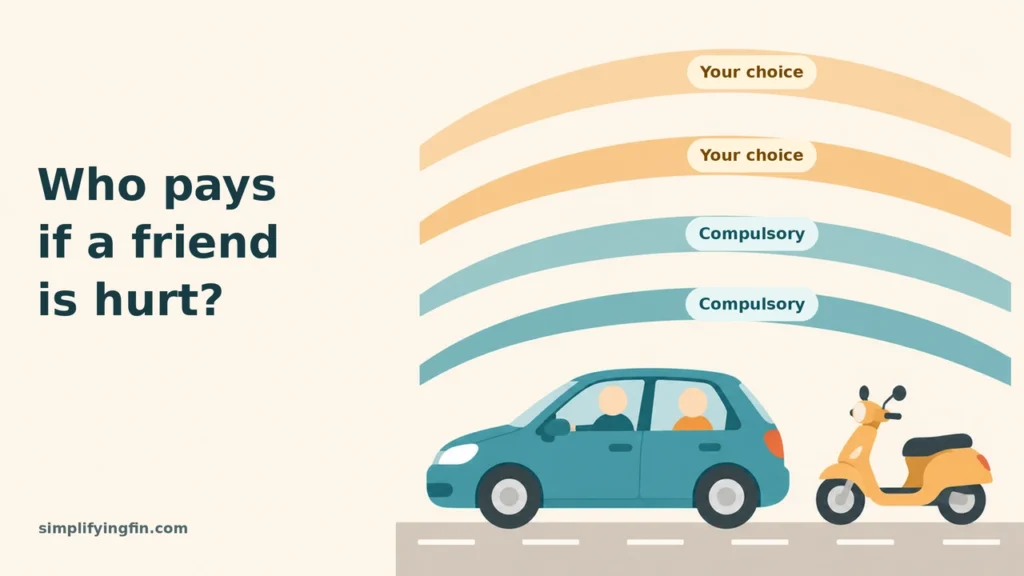
Quick answer: From 15 December 2026, every motor policy for a private car or two-wheeler in India must follow one standard four-layer motor insurance format. IRDAI issued the circular on 2 November 2026 to carry out a Supreme Court order.
Two covers stay compulsory: third-party liability (Section I) and personal accident (PA) cover for an individual owner-insured (Section III(i)), which has narrow opt-outs, such as PA cover already held elsewhere. Three covers become separate, separately priced tick-box choices: liability to occupants and pillion riders (Section II), PA for occupants (Section III(ii)) and own damage (Section IV).
You will sign, or OTP-confirm, an option form that becomes part of your policy, and you must receive a Customer Information Sheet at the point of sale. If a friend or colleague is hurt in your car, the covers that respond are Section II (your legal liability) and Section III(ii) (a fixed payout), and both are opt-in. The catch: no law forces you to buy own damage, so unticking it saves premium and leaves your own vehicle unprotected.
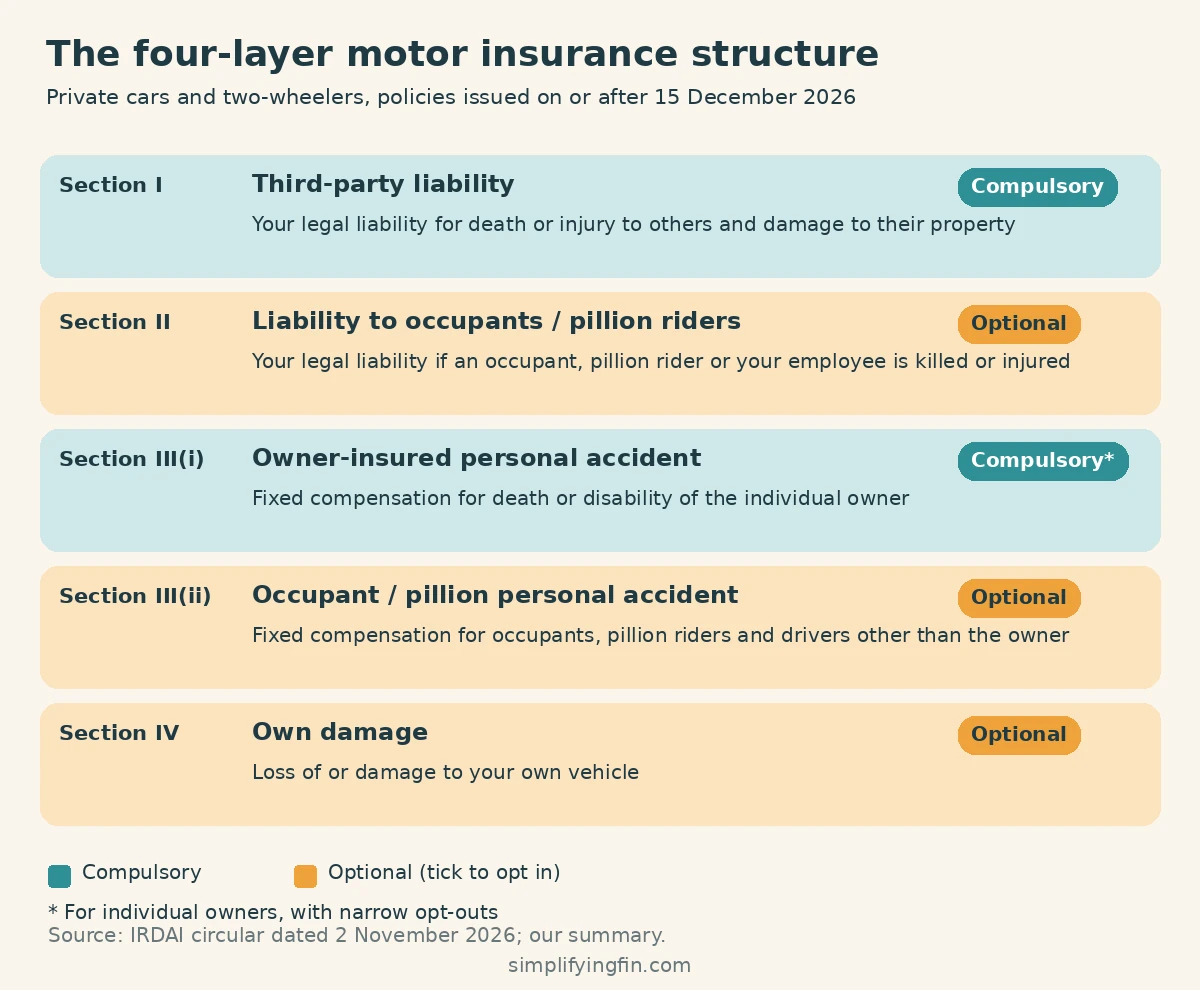
Table of Contents
In July 1996, a man was returning from Tirupati in his Maruti 800 when an unidentified lorry hit the car from behind. He died of his injuries. His family then spent about three decades in tribunals and courts to find out whether the insurer owed them anything.
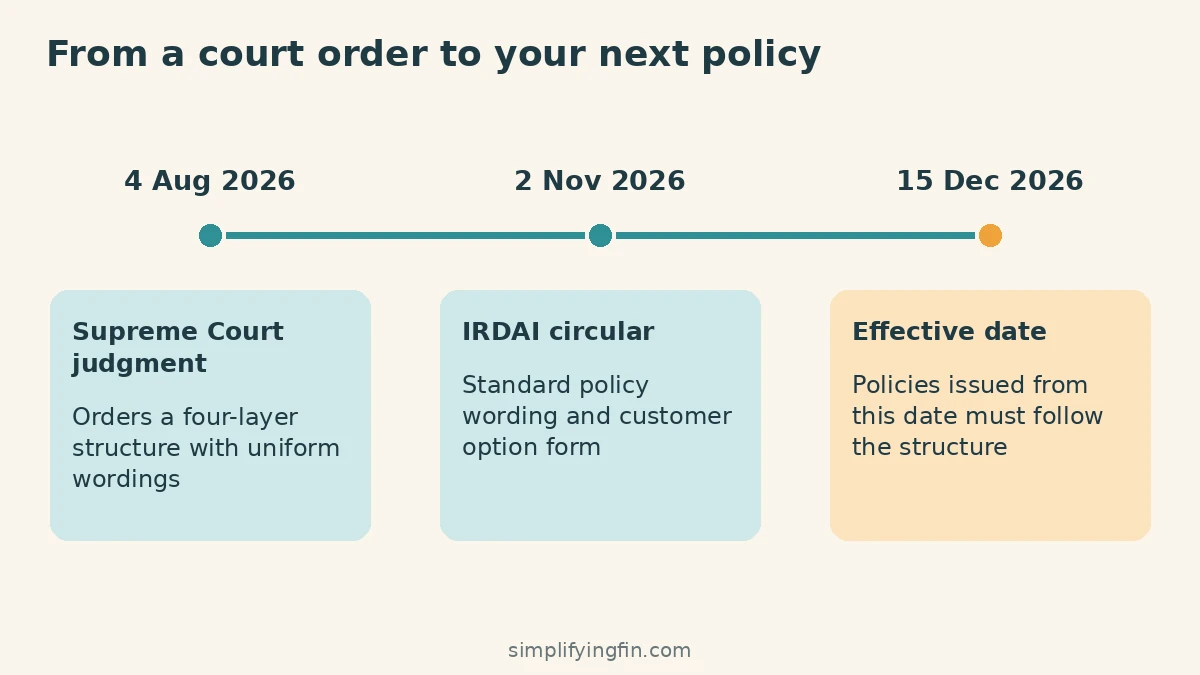
On 4 August 2026, the Supreme Court said yes. Then it did something unusual. It used that one old accident to order a reset of how motor insurance is sold to every private car and two-wheeler owner in India.
Three months later, IRDAI turned the order into a circular dated 2 November 2026. We read the circular and its 18-page annexure line by line and compared them with the court reports and early news coverage. If you ever give a lift to a friend or colleague, the question this change raises is simple: who pays when they get hurt? This article answers that, then covers the rest of the change and what is still unclear.
One thing up front: this reform covers private cars (including three-wheelers registered as private cars) and two-wheelers not used for hire or reward. Taxis, ride-hailing cars and commercial vehicles are outside it. Everything below is as of 9 November 2026.
The curious story behind the change
The family’s claim began with a simple question: if the owner dies while travelling in his own car, does his comprehensive policy pay? The tribunal said no in 2009, because no extra premium had been paid for the owner’s personal risk. The Telangana High Court disagreed in July 2024, treating him as an owner travelling as a passenger, and awarded Rs 10,00,500 with 7.5% annual interest. The judgment does not say who was at the wheel. The insurer appealed.
The Supreme Court dismissed the appeal on 4 August 2026 in National Insurance Co. Ltd. v. Smt. Thungala Dhana Laxmi & Others (Civil Appeal No. 14369 of 2025). It held that courts should not take a hyper-technical view of motor claims and, relying on a 2009 IRDA circular, that a package policy covers occupants.
Then the case grew bigger. The Court brought in 22 insurers, IRDAI and the transport ministry, and looked at the numbers:
- More than half of India’s vehicles are uninsured. The judgment cites nearly 56%, from a December 2024 Standing Committee on Finance report. Its own figures, 16.54 crore out of 30.48 crore, work out to about 54%, so read it as more than half.
- Around 22% of road accidents involve an uninsured vehicle, per MoRTH’s accident data cited in the case.
Policy wordings also differ from one insurer to another. The Court’s answer was a four-layer structure with uniform wordings drawn up by IRDAI with the General Insurance Council, plus a mandatory information sheet. The idea: if every cover has its own name, wording and price, you can see what you are buying and what you are leaving out.
Our read: the reform is less about adding new protection and more about making existing protection visible. That is useful, but it also moves responsibility from the insurer’s quote to your tick-box.
Think of it as a thali, not a set meal
Picture a Gujarati thali. Until now, many buyers were served a fixed plate: one bundled quote, one total premium, and a long document nobody finished reading. You paid for the whole plate even if you never touched the sweet.
From 15 December, the plate is broken into katoris. Dal and rice are served to everyone, because they are compulsory. The farsan, the sabzi and the sweet are listed on the menu with their own prices, and you tick what you want. The form is built so that you tick what you want, and the schedule must show the price of each katori.
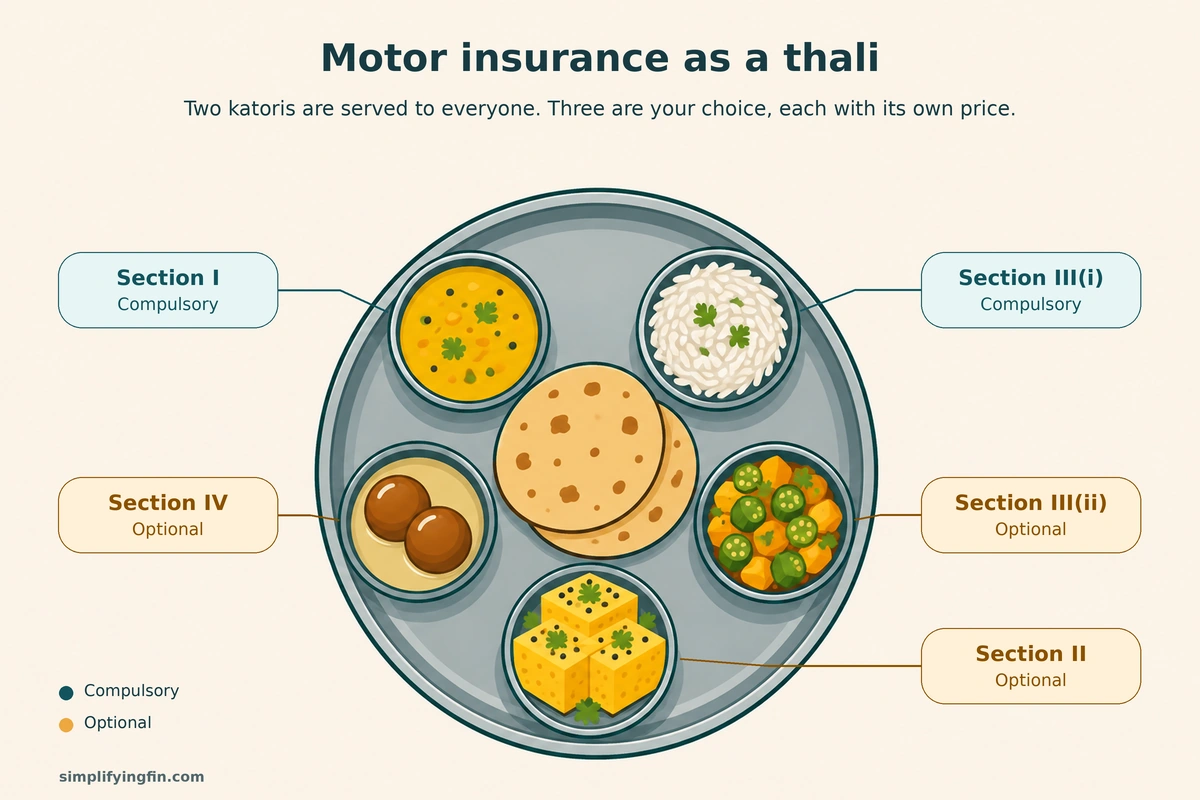
The risk with a menu is obvious. If you are watching the bill, you may skip the dish you needed most.
The four-layer motor insurance structure at a glance
| Section | What it covers | Compulsory? | Who it protects |
|---|---|---|---|
| I. Third-party liability | Your legal liability for death or injury to others and damage to their property, as the Motor Vehicles Act requires | Yes | People and property outside your vehicle |
| II. Legal liability to occupants / pillion riders | Your legal liability if an occupant, pillion rider or your employee is killed or injured | No, optional | You, against claims from occupants and employees |
| III(i). Owner-insured PA | Fixed compensation for death or disability of the owner in an accident | Yes for individual owners, with narrow opt-outs | The registered owner |
| III(ii). Occupant / pillion PA | Fixed compensation for death or disability of occupants, pillion riders and any driver other than the owner | No, optional | Occupants and drivers |
| IV. Own damage | Loss of or damage to your own vehicle | No, optional | Your vehicle |
Source: IRDAI circular IRDAI/NL/CIR/MISC/145/11/2026 dated 2 November 2026 and its annexure. Our summary.
So who pays if your friend is hurt in your car?
Short answer: it depends on who caused the accident and which boxes you ticked. These are five common situations, in our plain-words reading of the circular and annexure. They are not IRDAI’s own examples.
| Situation | Which cover responds | Our read |
|---|---|---|
| A friend is hurt and the other driver was at fault | The other vehicle’s third-party insurance, through a claim against that driver or owner | Generally the claim lies against whoever caused the accident, so your own policy is not the main source. |
| A friend is hurt, you were at fault, and you ticked Section II | Section II, within the limits and seating capacity | The insurer indemnifies you for what you are legally liable to pay, subject to policy terms. The friend must not be carried for hire or reward. |
| A friend is hurt, you were at fault, and you did not tick Section II | Section I, only as far as the Motor Vehicles Act requires | The exception for persons carried in the vehicle stays in force. Expect a dispute and possible personal exposure. Tribunals may read it differently. |
| You want your friend to receive money whoever is at fault | Section III(ii), if ticked | A fixed benefit on the annexure’s scale for death or disability. It pays the injured person, not you. |
| Your spouse, parent or child is hurt | Section II excludes immediate family. Section III(ii) does not carve them out | For your own household, occupant PA is the cover to look at. |
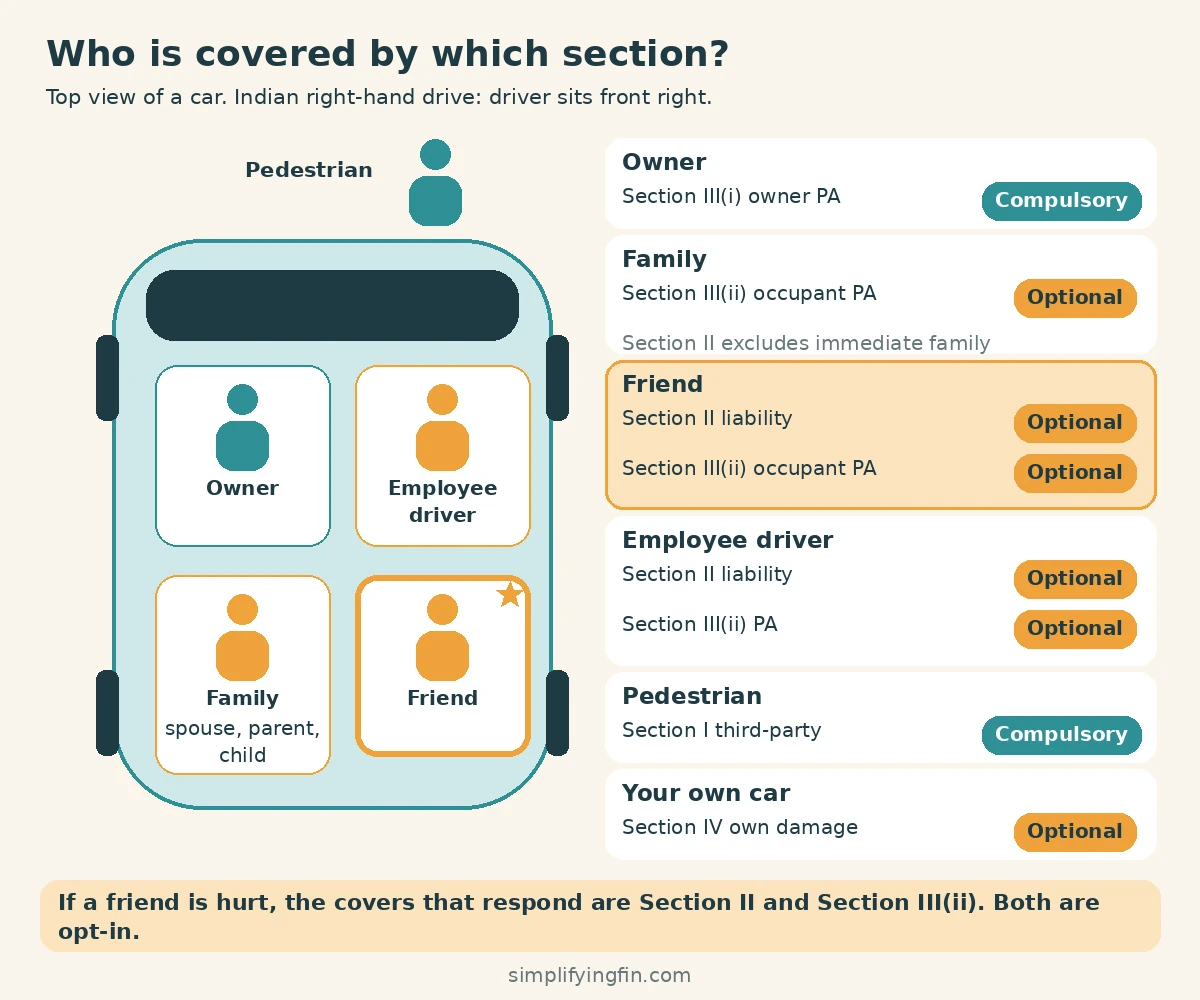
Why we hedge: before this reform, courts often read package policies as covering occupants, and the Thungala judgment did too. Whether a tribunal will keep doing that when a buyer unticks Section II is untested. If you regularly carry friends or colleagues, ticking Section II is the clear way to avoid the argument.
Section I: third-party liability, the cover the law insists on
Section I is the base. It protects you when your vehicle injures or kills someone else, or damages someone else’s property. The insurer indemnifies you for the amounts you become legally liable to pay, to the extent the Motor Vehicles Act, 1988 requires. It extends to a driver using the vehicle with your permission.
Three details are worth knowing:
- It does not pay for your own car or for you. Section I only deals with other people and their property.
- It is hard to cancel. The annexure says Section I cannot be cancelled except for double insurance, established fraud, or total or cash loss.
- It follows the use of the vehicle. Hire or reward, carrying goods, racing and motor trade use are among the uses the policy does not cover.
Section II: the cover most people will overlook
What it covers
Section II is the cover for your legal liability to people travelling in your vehicle: occupants, pillion riders and any employee of yours who is driving or travelling in it. It is optional, it carries an additional premium, and it is limited to the seating capacity of the vehicle, including the driver.
Who is left out
The annexure excludes the owner or insured, the insured’s immediate family, and any driver who is not your employee. Immediate family is defined as parents, spouse and children. So Section II is not meant for your family. It is meant for the colleague you drop home, the friend on the pillion seat and the driver you employ.
How the exceptions work
Our read, not an IRDAI clarification: the annexure treats two general exceptions as omitted only if Section II is opted. They say the insurer is not liable for injury to an employee-driver, or to people carried in the vehicle, beyond what the Motor Vehicles Act requires. So without Section II those exceptions stay in force, and your protection for occupant claims may be narrower than a package policy gave you. Expect this to be tested before tribunals.
Section III: personal accident, one compulsory and one optional
III(i): owner-insured PA, compulsory for most owners
This is the personal accident cover for the registered owner. It pays a fixed benefit if the owner dies or is seriously injured in an accident connected with the insured vehicle, whether driving, getting in or out, or travelling in it. The benefit scale in the annexure is:
- 100% of the sum insured for death, loss of two limbs or two eyes, loss of one limb and one eye, or permanent total disablement.
- 50% for loss of one limb or one eye.
The injury must result in the loss within six calendar months, and only one benefit is payable for one occurrence. Suicide, intentional self-injury and physical defect or infirmity are excluded. The sum insured follows the existing compulsory PA rules, which have been reported at Rs 15 lakh since 2018. The circular does not state the amount.
Five rules matter in practice:
- Only individuals. A company, partnership firm or other body corporate cannot get this cover. No premium is charged for it and the cover is deleted.
- One vehicle only. If you own several vehicles, owner PA is granted for only one, as you choose. If you hold it on more than one, a claim is paid under only one policy.
- Opt-out if you already hold PA elsewhere. The option form lets you decline it if you already have PA insurance with another insurer. Under IRDAI’s 2018 rules, as reported, that other policy should be a 24-hour PA cover of at least Rs 15 lakh.
- Needs a valid licence. IRDAI’s October 2018 circular says compulsory PA does not apply where the owner-driver has no valid driving licence. The 2 November annexure also requires a valid licence if the owner is driving.
- No proof field. The form has no space for the other insurer’s name, policy number or sum insured. Keep that proof yourself.
III(ii): occupant and pillion PA, optional
This is the same fixed-benefit idea, extended to occupants, pillion riders and any driver other than the owner-insured. You choose the sum insured and the number of seats on the form, up to the seating capacity printed on the registration certificate. The driver must hold a valid licence.
Liability cover and PA cover are different things. Section II protects you when an injured occupant claims compensation from you. Section III(ii) pays the injured person a fixed sum whether or not anyone is at fault.
Section IV: own damage, optional and insurer-priced
Section IV pays for loss of or damage to your own vehicle. The annexure does not fix its terms: it follows each insurer’s existing offering of basic own damage and add-ons, and the circular lets insurers keep pricing it in line with the market. They can also add or delete general exclusions and conditions, provided basic cover under the four layers is not restricted.
What the annexure does set out, in plain words:
- Total loss: the insurer pays up to the insured declared value (IDV) of the vehicle, including accessories, less the value of the wreck.
- Partial loss: actual and reasonable repair or replacement costs, subject to depreciation limits.
- Deductibles: the compulsory and voluntary deductible percentages are recorded on the option form.
- If you do not opt in: the conditions on settling losses and safeguarding the vehicle are deleted.
Tata AIG General’s head of motor underwriting told Business Standard he expects more competition on own damage, and also that customers may drop optional covers without understanding them. Both can be true at once.
Exclusions that apply across the policy
Some general exceptions apply to every section unless the annexure says otherwise. Three matter most to everyday drivers. The insurer is not liable when the vehicle is used outside the stated limitations as to use, such as hire or reward. It is not liable when the vehicle is driven by someone outside the Driver clause, which in plain words means a person without a valid licence for that vehicle. And it is not liable when the driver is under the influence of alcohol or drugs, as described in section 185 of the Motor Vehicles Act. Ticking every box does not cancel these.
The option form and the information sheet
Two documents now sit at the centre of every motor sale.
The Customer Option Form
The circular makes a completed option form mandatory for every policy in this category. It can be offline or online, you tick your choices, and it becomes part of the policy. If it is collected digitally, consent is given through an OTP sent to your mobile number or e-mail.
From the printed annexure, the form has:
- A proposer and vehicle panel: proposer, intermediary name, registration number, vehicle type, registered seating capacity, UIN and product name.
- A table of the sections with Opt In and Opt Out boxes, and a premium column beside each one.
- Space for the PA sum insured, seating capacity covered, deductible percentages, the total with GST and your signature.
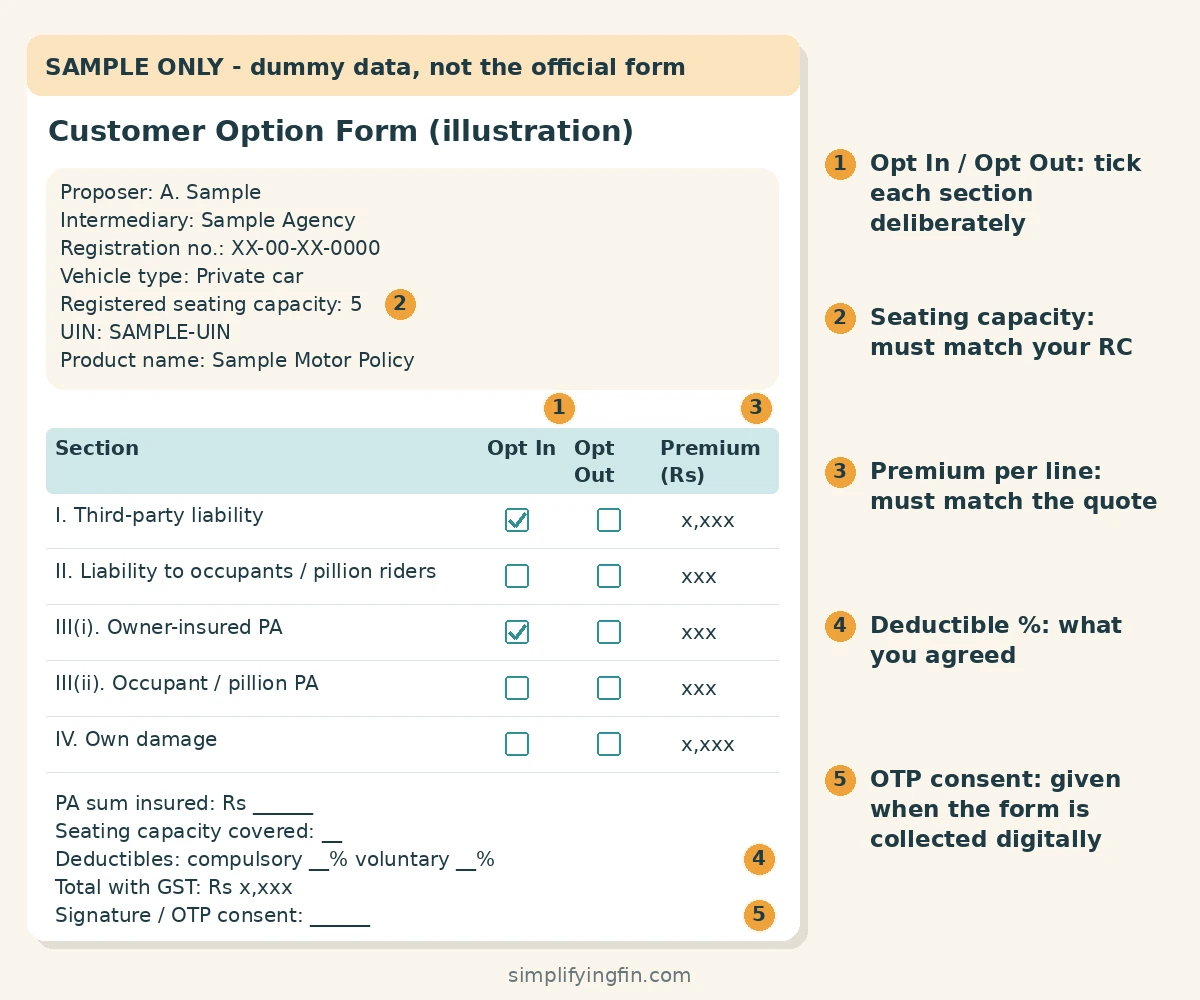
The schedule that comes with your policy must then show the actual coverage and the premium charged against each section, and the certificate of insurance must follow the CMV Rules, 1989.
The Customer Information Sheet
The circular also makes it mandatory to issue a Customer Information Sheet at the point of sale. We could not find a format for it. The annexure contains the policy wordings and the option form only.
Before you sign, check: the seating capacity matches your registration certificate, each premium line matches the quote, the deductible percentages are what you agreed, and the IDV in the schedule is realistic for your vehicle. Keep a copy of the signed or OTP-confirmed form.
If you already hold a policy, or you are renewing
Policies running today
The circular says policies issued on or after 15 December must conform. It does not ask insurers to rewrite policies issued before that date.
It does give existing policyholders one new option: if you want Section II during the policy period, you can add it by paying an additional premium. Cover starts from the date and time on the endorsement issued to you, which matches the long-standing rule that premium must be received before the risk starts. You can only take it from the insurer that issued your third-party policy, and nobody has to cancel an existing third-party policy to do so.
Note what is missing: the circular mentions only Section II for mid-term additions, not occupant PA or own damage.
Renewals of older vehicles
Here the wording is not tidy. Paragraph 3 says insurers must use the four-layer structure for all private vehicles, including new cars and new two-wheelers. Paragraph 2 speaks of options after the structure is introduced for new cars and new two-wheelers.
Our read: the better reading is that a renewal issued after 15 December is a new policy issued after that date and should follow the structure. Several explainers read it the same way. But IRDAI has not published a clarification as of 9 November, so ask your insurer before your renewal date.
If you have a car or bike loan
The four-layer rules do not change your loan agreement. Most lenders require the vehicle to be insured, usually with own-damage cover, and to be hypothecated to the lender. Nothing in the circular compels own damage. So the safe assumption is that your loan document, not the regulator, tells you what you must buy.
From 15 December, the option form and the schedule will show clearly whether you opted into Section IV. If you untick it on a financed vehicle to save premium, you could end up breaching a loan condition and be left without cover if the vehicle is damaged or stolen.
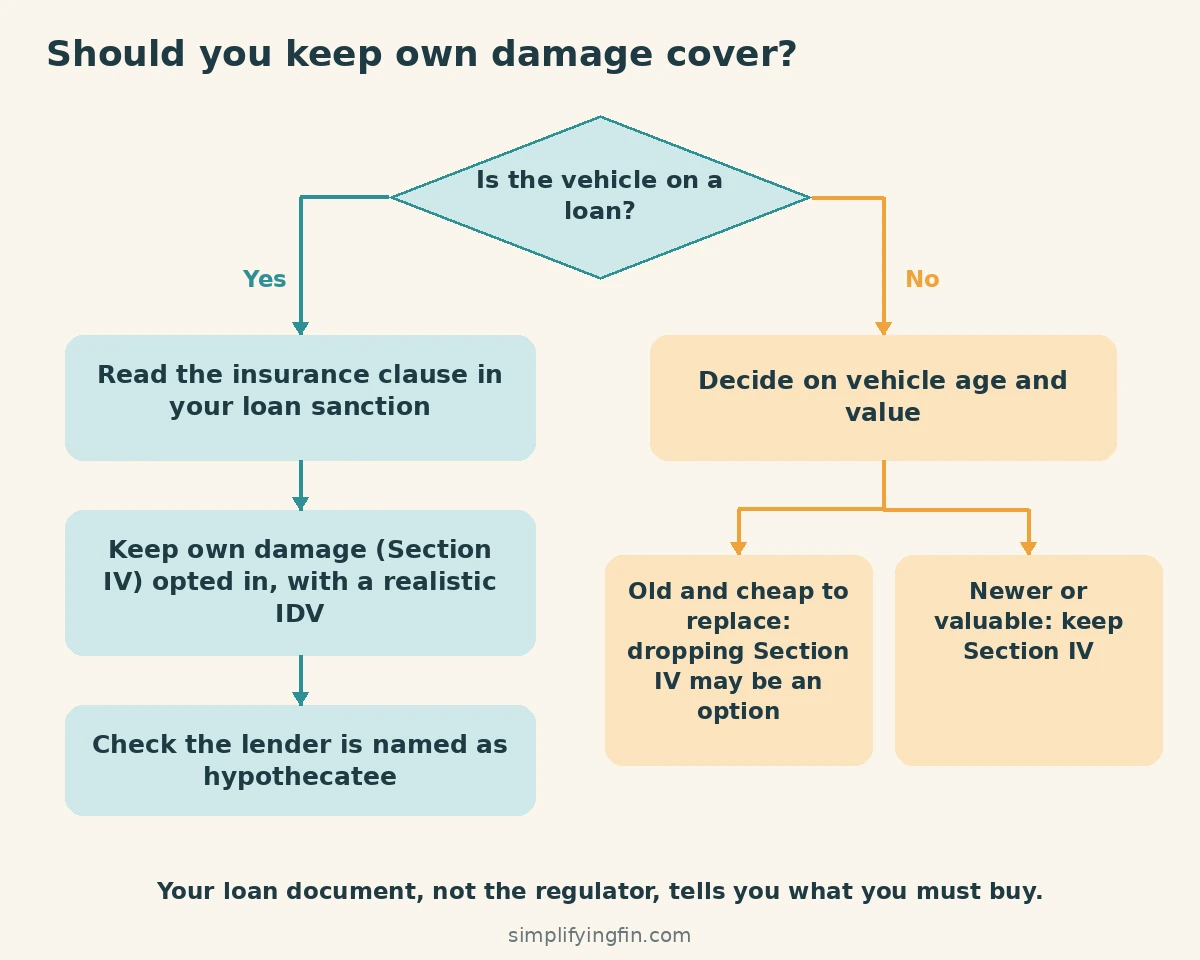
- Read the insurance clause in your loan sanction before you tick anything.
- Keep own damage opted in, with an IDV that reflects what the vehicle is worth.
- Check that the lender’s name appears as hypothecatee on the policy.
- Keep a copy of the option form with your loan papers. If you use another PA policy to opt out of owner PA, keep that too, because the form does not record it and a lender may ask.
What could go wrong, and what is still unclear
We found no IRDAI FAQs, clarifications or addenda between 2 and 9 November. Until they arrive, watch these points:
- Renewals and “new” vehicles. Covered above. A clarification would remove the doubt.
- The missing information sheet. The circular makes it mandatory but does not supply a format.
- Mid-term additions. Only Section II is addressed.
- A tight timeline. Insurers have about 45 days to redraft wordings, forms and sales systems, and one insurer executive told Business Standard that is demanding.
- Bima Sugam. The circular tells insurers to integrate the four-layer policies with Bima Sugam from the same date. In late October the IRDAI chairman reportedly said the platform was not yet operational, so the date is at risk.
- Tenure of third-party cover. The Supreme Court directed 4-year third-party cover for new cars and 6-year for new two-wheelers, against the regulator’s own view. The current practice remains 3 and 5 years until IRDAI issues directions. We found no IRDAI circular implementing the change and no revised third-party premium notification. The 2 November circular does not mention it.
- Under-insurance. With more than half of vehicles already uninsured, the realistic worry is more policies with only the two compulsory covers, a risk for occupants and lenders.
A note on sources: some websites print a different reference number for the circular. Use the one printed on the PDF from IRDAI, IRDAI/NL/CIR/MISC/145/11/2026.
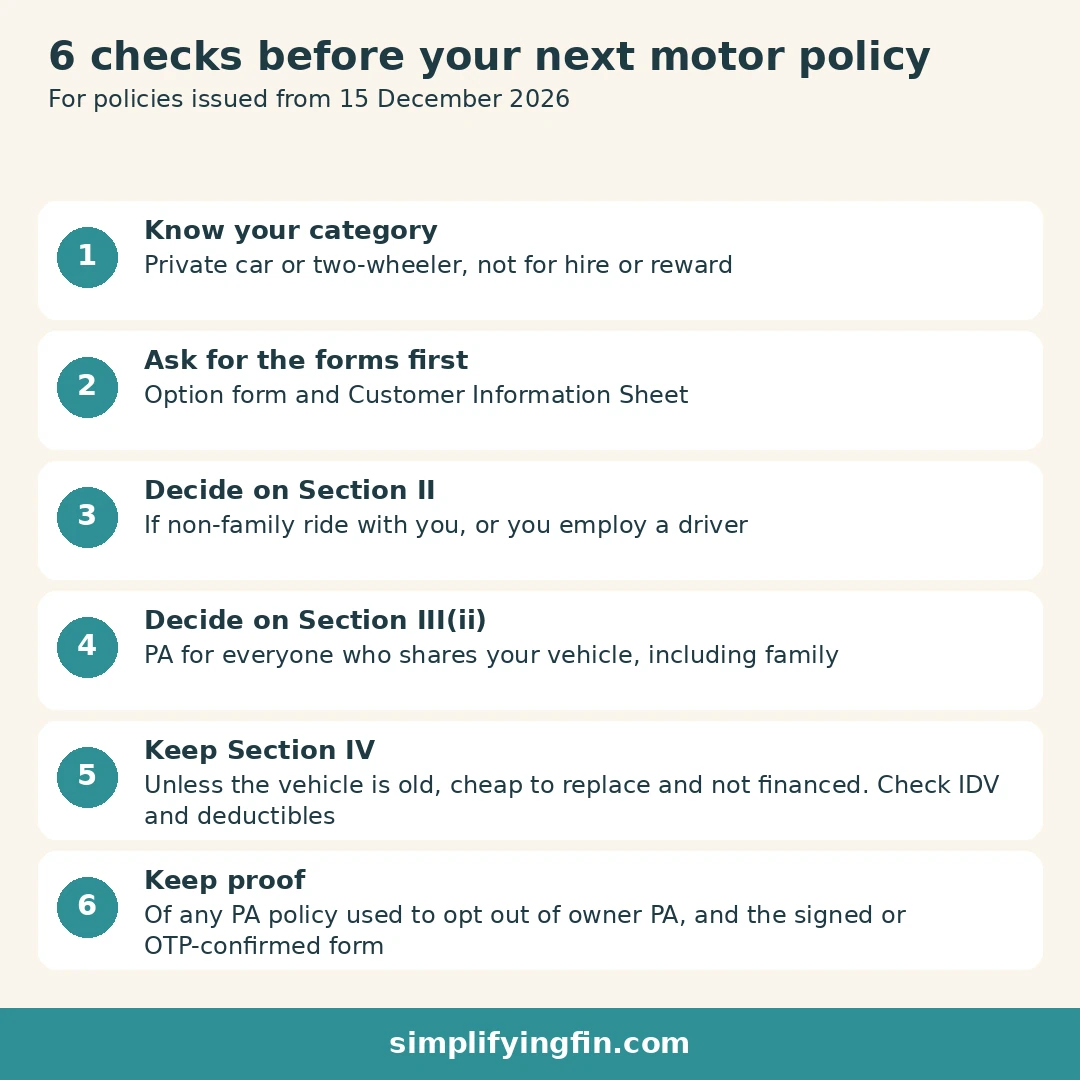
A six-step checklist before your next motor policy
- Ask which vehicle category you are in. Private car or two-wheeler, not for hire or reward.
- Ask for the option form and the information sheet first. Do not accept a policy without them.
- Decide on Section II if anyone other than your family regularly rides with you, or if you employ a driver.
- Decide on Section III(ii) for the people who share your vehicle, including family.
- Keep Section IV unless the vehicle is old, cheap to replace and not financed. Check the IDV and the deductibles.
- Keep proof of any PA policy you use to opt out of owner PA, and a copy of the signed or OTP-confirmed form.
Key takeaways
- From 15 December 2026, every private car and two-wheeler motor policy follows one four-section format with uniform wordings.
- Two covers are compulsory: third-party liability, and owner PA for individual owners, with narrow opt-outs.
- Occupant liability, occupant PA and own damage become priced, separate, optional choices.
- Nothing makes own damage compulsory by law, but your loan agreement may.
- Several points are still open: renewals, the information sheet format, mid-term additions and Bima Sugam readiness.
Frequently asked questions (FAQs)
Who pays if a friend is injured in my car?
It depends on who caused the accident. If the other driver was at fault, the claim generally lies against that driver’s insurer. If you were at fault, Section II covers your legal liability, if you ticked it. Section III(ii), if ticked, pays a fixed benefit whoever is at fault.
What is the four-layer motor insurance structure?
It is a standard format for private car and two-wheeler policies with four sections: third-party liability, liability to occupants and pillion riders, personal accident cover, and own damage. Each has uniform wording and its own premium in the schedule.
When does it start?
It comes into force on 15 December 2026. All policies issued from that date must conform to it.
Which covers are compulsory?
Third-party liability (Section I) and owner-insured personal accident cover (Section III(i)) for individual owners. Narrow opt-outs exist for owner PA: for example, you already hold PA cover elsewhere or on another vehicle, or you have no valid driving licence.
Is own damage cover compulsory?
No. Section IV is optional under the circular. A loan agreement or the lender’s conditions may still require it, so check before you tick.
Does it apply to my existing policy?
Policies issued before 15 December are not rewritten. You can add Section II mid-term from the insurer that issued your third-party policy, for an additional premium, with cover from the endorsement date and time.
What about renewals of older vehicles?
The circular’s wording is not fully clear on whether it means new vehicles only or all private vehicles. The better reading is that renewals from 15 December follow the structure. Confirm with your insurer.
Does it apply to taxis, cabs and commercial vehicles?
No. The structure is for private cars and two-wheelers not used for hire or reward. Passengers in cabs are outside this reform.
Can an insurer issue a policy without the option form?
No. The circular says obtaining a duly completed option form is mandatory for every policy in this category, and the form forms part of the policy.
Disclaimer: This article is for education only. It is not insurance, legal, tax or investment advice. Figures from court reports and news sources are as reported and may be rounded. The circular and annexure were read from the printed PDFs as of 9 November 2026, and IRDAI may issue clarifications. Examples with named people are illustrations, not real cases or quotes. Please read your own policy documents and consult your insurer or a qualified adviser before deciding. Read our full Disclaimer page.
Sources:
- IRDAI circular IRDAI/NL/CIR/MISC/145/11/2026 dated 2 November 2026 and annexure (Standard Motor Insurance Policy for Private Car/Two Wheelers and Customer Option Form), read from the PDFs. IRDAI Non-Life page
- National Insurance Co. Ltd. v. Smt. Thungala Dhana Laxmi & Ors., CA No. 14369 of 2025, 2026 INSC 793, decided 4 August 2026. Judgment text and Verdictum report
- Business Standard, 4 November 2026: report on the four-layer structure and report on insurers warning against opting out of key covers
- Moneylife, 4 November 2026
- Outlook Money
- Upstox
- IRDAI circular IRDAI/NL/CIR/MOTP/170/10/2018 (October 2018) on compulsory personal accident cover, as hosted by IBAI
- Business Today, 5 November 2026
Read next: Bank of India Q2 FY27 results explained | The FCNR(B) swap story
Useful tools: Loan EMI calculator | Four-wheeler loan eligibility calculator | More explainers on our Banking category and Blog page